OpenClinica has seen a surge in usage over the past year, according to recent survey conducted by Akaza Research.
“Our annual survey of the OpenClinica community showed strong expansion in all key measurements of system usage,” said Cal Collins, Chief Executive Officer at Akaza. “In the past year we have seen doubling in the number of OpenClinica users and subjects, and a nearly 10-fold increase in regulatory submissions.”
The company reports that a reported 168,989 subjects have been involved in OpenClinica-powered clinical trials, a 224 percent increase from the prior year. In tandem, the company identified a 246 percent increase in the number of OpenClinica software users. The figure measures users working at the sponsor or CRO level and does not include users at clinical trial sites.
“Since these figures are based on a voluntary survey of the OpenClinica community, they are likely underestimates,” said Collins. “While it can be difficult to precisely measure the usage of freely distributed open source software, they provide a clear indication of the growth in OpenClinica adoption around the world,” he added.
The Professional Open Source Model
OpenClinica stands in stark contrast against the landscape of other EDC products that are provided under a closed source license. Akaza Research’s “professional open source” business model makes OpenClinica available in two editions. The OpenClinica Community Edition is freely available to use and modify, and may be downloaded form http://www.openclinica.org. The OpenClinica Enterprise Edition is a certified build of the open source technology commercially supported by Akaza Research. In many respects, the company’s business model is similar to that of RedHat (Linux), MySQL (database software), and other open source companies.
The OpenClinica rapidly growing open source community currently comprises over 10,500 users and developers, many of whom help review and adapt the open source software. Roughly 33 percent of OpenClinica users are located in North America, 30 percent in Europe, 14 percent in Asia, 9 percent in Africa, 7 percent in South America, and 7 percent in Australia. OpenClinica community members drive much of the product’s evolution, and in recent years have helped to usher the technology into a wide variety of clinical trial settings.
Worldwide Acceptance in Regulated Trials
The composition of the OpenClinica community is changing over time, with an increasing number of OpenClinica users representing commercial clinical trials. Currently, 55 percent of the OpenClinica community members identifies themselves as working in industry, with the remainder in academic or government settings.
According to Collins, “the robust overall growth is highlighted by an increasing proportion of OpenClinica users representing pharmaceutical, biotech, device, and other companies. We saw a 975 percent increase in OpenClinica-powered trials used in regulatory submissions in the past year, and in the next 12 months OpenClinica adopters expect to increase this number by another 200 percent. This is consistent with our OpenClinica Enterprise Edition customer growth, where a majority of new customers are from industry.”
For more information about OpenClinica see the OpenClinica website.
Filed under: Case Studies | Tagged: Akaza Research, clinical data management software, clinical trials software, commercial open source, community, electronic data capture, OpenClinica adoption, OpenClinica Enterprise, OpenClinica usage, OpenClinica users, professional open source | 1 Comment »
OpenClinica Community Surpasses 10,000 Members …and oh yeah, what is this open source thing?
Heartfelt thanks to everyone who has supported the OpenClinica project over its relatively brief history. Our community now stands at over 10,000 registered members, representing a 3-fold increase in size over the past two years alone. With members in over 70 countries across six continents, open source is now a central part of the clinical trials software landscape. This is a major accomplishment that we should all be proud of.
While 10,000 may sound like a lot of people, there are still many within the clinical trials industry who do not understand the key concepts of open source. Other software categories have a high prevalence of open source offerings. For instance, when you look at database products (like MySQL, Postgres) and operating systems (like Linux, Android, BSD) there are numerous open source options. Open source is even widely prevalent in the EMR/EHR space, with OpenVista, and over 20 others to choose from.
As OpenClinica ushers the benefits of open source into the clinical trials space, it is instructive to periodically revisit the fundamentals of what exactly open source is.
What is open source?
Open source is a type of free software license–free as in “freedom,” not “beer.”[1] It is not “freeware” and it is not “shareware.” More specifically, open source provides users with[2]:
There are numerous open source software licenses based on the above tenants and roughly 60 open source licenses have been approved by the non-profit Open Source Initiative. The OpenClinica Community Edition is distributed under the LGPL open source license.
Open source as a development model
The software development models around open source projects are typically characterized by transparency and collaboration within the community. Opening the product up to the community, allowing anyone to see the good with the bad, helps to quickly uncover problems and identify areas for improvement. Most open source projects will publicly maintain a project roadmap and defect tracking system. Release cycles of active open source projects tend to be early and often.
The result of such openness and transparency is software that is often more reliable and better performing than proprietary, closed alternatives.
What is professional open source?
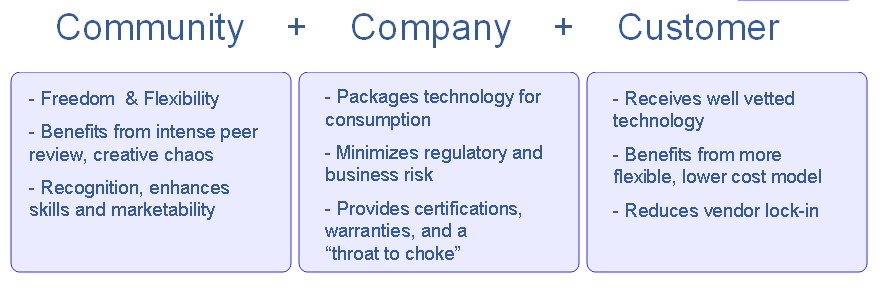
A symbiotic relationship exists in a health professional open source model between the Community, Company, and Customer.
Some people may think of open source projects as purely volunteer efforts. That is definitely not the case! While governance models vary from project to project, commercial enterprises have helped make open source consumable by ordinary people and businesses. For example, through its OpenClinica Enterprise Edition, Akaza Research provides support and regulatory assurances that help to minimize business risk and ensure success for organizations wishing to use OpenClinica in mission critical settings. Organizations can turn to Akaza to rapidly develop in-house expertise, obtain hosting and expert professional services, and ensure their OpenClinica systems and users are productive and satisfied.
A pervasive trend in software
Open source is everywhere[3]. From the Firefox web browser to the most popular websites, everyone who uses the World Wide Web uses open source. As web-based technology, OpenClinica and the OpenClinica community are direct beneficiaries of numerous other open source projects. Those within the clinical trials space who recognize the significance of open source will be a step ahead of their colleagues.
- Ben Baumann, Co-Founder, Akaza Research, LLC
Want to be an OpenClinica Community Member? Members get free access to OpenClinica software downloads, Issue Tracker, email forums, and the OpenClinica Case Report Form (CRF) Library. Register at http://www.openclinica.org/register.php.
Footnotes:
[1] See Open Source Software Definition, http://www.opensource.org/docs/osd
[2]From the Free Software Foundation: http://www.fsf.org/licensing/essays/free-sw.html
[3]The SourceForge repository of open source codebases counts over 230,000 OSS projects.
Filed under: Industry Commentary | Tagged: clinical trials, clinical trials software, commercial open source, electronic data capture, Linux, open source, OpenClinica, openvista, oss, professional open source | 1 Comment »