Rapid Deployment of New Functionality in OpenClinica Using MirthConnect

In a previous article, we describe how we at Geneuity Clinical Research Services exploit OpenClinica’s new web services feature to automate the entry of lab data keyed to accession numbers.  Here, we describe more fully how and why we use MirthConnect.

Started in 2006, MirthConnect is an open source project sponsored by the Mirth Corporation of Irvine, CA.  It is middleware designed to transform, route and deliver data.  It supports HL7, X12, XML, DICOM, EDI, NCPDP and plain old delimited text.  It can route via MLLP, TCP/IP, HTTP, files, databases, S/FTP, Email, JMS, Web Services, PDF/RTF Documents and custom Java/JavaScript.  MirthConnect has been likened to a Swiss army knife and justifiably so.

Channels are the heart and soul of a MirthConnect installation.  A channel is user defined and has a source and a destination.  A source may be a flat file residing on a remote server or a web service call or a database query or even another channel—whatever you like, it doesn’t matter. A destination may be to write a PDF document, email somebody an attachment or enter data into a database.  Again, whatever!

To illustrate, say you want to poll a database and generate a weekly report.  No sweat! Using MirthConnect’s easy-to-use drag-and-drop template-based editor, define a channel with a database reader as a source, and a document writer as a destination, fill in details like user names, passwords and machine names, define which database fields you want to retrieve and how you want to display the data, and you’re done!  MirthConnect’s daemon handles the rest based on your channel’s configuration.

Once defined, a channel can be exported as XML for later import into another MirthConnect installation.  This is all done with the point and a click of a mouse.

At Geneuity, we use MirthConnect to get data in and out of OpenClinica.  Originally, we used custom JAVA code to do this.  But once we found MirthConnect, we quickly realized we were reinventing the wheel.  Why do that?

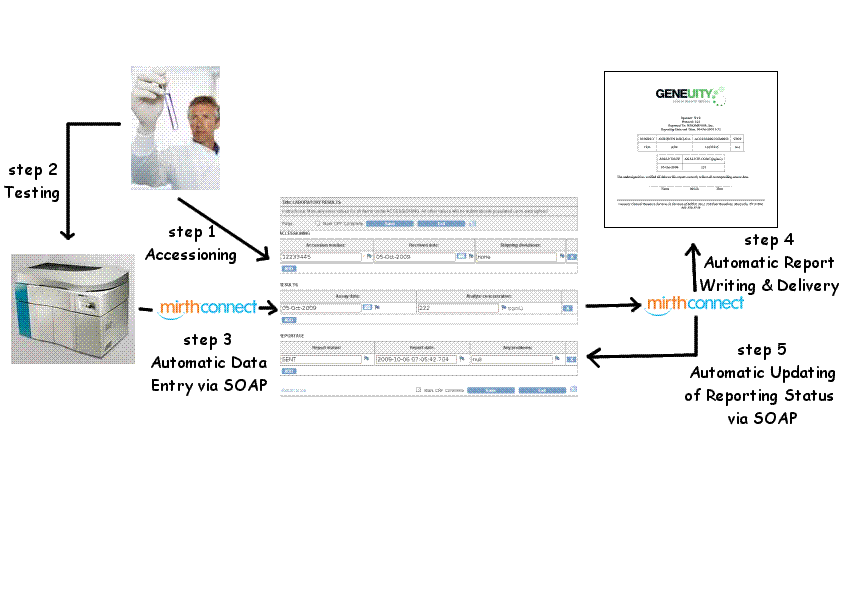
Here’s a concrete example.  Consider the very simple CRF from a mock OpenClinica installation shown in Figure 1.  It has three groups of items: accessioning, results and reportage.  When a specimen arrives at Geneuity, the lab tech looks up the patient and event pairing in the subject matrix as specified by the requisition and types into the CRF the accession number, the receipt date and any shipping deviations.  This is done by hand and is indicated as step 1 of Figure 2.

Then, as shown in step 2 of Figure 2, the tech tests the specimen at the testing platform.  In step 3, the platform spits out the data whereupon a collection of MirthConnect channels operating in tandem parses the results, transforms them into SOAP messages and sends them to the EventDataInsertEndpoint web service feature of OpenClinica for upload into the CRF fields designated ‘Assay date’ and ‘Analyte concentration’.

After the tech reviews the data and marks it complete, another collection of channels polls the database for results newly marked complete, generates and delivers PDF reports of the corresponding data (step 4) and then reports back to OpenClinica (step 5) via EventDataInsert the details of the reportage, including status, time and any errors (see the third and last item grouping labeled ‘REPORTAGE’ in Figure 1).

The scenario outlined above requires NO CUSTOM CODE beyond the channel configurations and these are encapsulated and standardized by design.  As such, you don’t need an army of coders on staff to develop and maintain them.

Both OpenClinica and MirthConnect are great as standalone products.  Linked together, however, they really sizzle.

Figure 1: A simple CRF from a mock OpenClinica installation
Figure 2: This shows how the different item groupings in the CRF depicted in Figure 1 are populated.  Values for items under ACCESSIONING are entered manually by the lab tech.  Values for items under RESULTS are populated by the Mirth channels continuously listening for in-coming data from the clinical testing platform.  Values for items under REPORTAGE are populated by a distinct set of  Mirth channels responsible for polling and reporting newly completed results.

Figure 2: This shows how the different item groupings in the CRF depicted in Figure 1 are populated. Values for items under ACCESSIONING are entered manually by the lab tech. Values for items under RESULTS are populated by the Mirth channels continuously listening for in-coming data from the clinical testing platform. Values for items under REPORTAGE are populated by a distinct set of Mirth channels responsible for polling and reporting newly completed results.

An Opportunity for Transformational Change in Clinical Trials

Life sciences research is recognized as one of the most technologically advanced, groundbreaking endeavors of modern times. Nevertheless until very recently the preferred technology for executing the most critical, costly stage of the R&D process – clinical trials – has been paper forms. Only in 2008 did adoption of electronic alternatives to paper forms take place in more than half of new trials. This recent uptick in adoption rates is encouraging, but further transformational change in the industry is necessary to fully realize the promise of Electronic Data Capture (EDC) and associated “eClinical” technologies. Two developments that could provide the framework for such change are adoption of open data standards and the use of Open Source Software.

Data standards provide uniform ways to represent information or processes within a specific frame of reference and according to a detailed specification. A standard is “open” when it is not encumbered by patent, cost, or usage restrictions. Open Source Software (OSS) is defined loosely as software that allows programmers to openly read, redistribute, and modify the source code of that software. The combination of OSS and open standards is a proven way to deliver improved flexibility, quality, and efficiency.

A community-driven open source offering that harnesses open standards can produce robust, innovative technology solutions for use in regulated clinical trial environments. Most Open Source Software is built using a collaborative development model. The OSS development and licensing model encourages experimentation, reduces ‘reinvention of the wheel’, and allows otherwise unaffiliated parties to build on the work of others. The result is that OSS can become a key driver of increased IT efficiency and a way to wring out unnecessary costs. In many cases, users can have the best of all worlds: the ability to adopt software rapidly and at low cost, the flexibility to develop and extend their systems as they choose, and the ability to reduce risk by obtaining paid commercial-grade support.

As clinical research struggles to become more automated and efficient, we need to rely on interoperable systems to meet challenges of flexibility, quality, and speed. The OSS development model also naturally leads to the adoption of well-documented, open standards. Because OSS product designers and developers tend to reuse successful components and models where available, OSS technologies are often leading implementers of standards. For example, the National Cancer Institute’s Cancer Bioinformatics Grid (caBIG) initiative is “designed to further medicine’s potential through an open source network” based on open data standards and infrastructure that support sharing of heterogeneous data. This remarkable effort aims to connect large networks of researchers in ways that enables efficient re-use of data, eliminates duplicate systems, and enables new types of translational research.

In industry-sponsored clinical trials, standards such as the CDISC Operational Data Model (ODM), Clinical Data Acquisition Standards Harmonization (CDASH), and Study Data Tabulation Model (SDTM) have gained adoption in both proprietary and OSS software platforms. In some cases, standards are mandated for regulatory submission and reporting (SDTM, clinicaltrials.gov) and obviously must be adopted. Other cases, such as use of ODM, CDASH, and general web standards such as web services and XForms tend to be adopted to the degree they have a compelling business case.

The business case for standards centers on increasing accuracy and repeatability, enabling reuse of data, and enhancing efficiency by use of a common toolset. A well-designed standard does not inhibit flexibility, but presupposes idiosyncrasies and allows extension to support ‘corner cases’. Leading industry voices share compelling arguments how to use standards such as ODM, CDASH, XForms, and Web Services to achieve these goals. Though the details are complicated, the approach offers orchestration of disparate applications and organization of metadata across multiple systems. There is change control support and a single ‘source of truth’ for each data point or study configuration parameter, so when study designs change (as they inevitably do) or a previously committed data point is rolled back, it is automatically shared and manual updates to systems are not necessary. Because the ODM, CDASH, and SDTM are used as a common “language”, the systems know the meaning and structure of data and can process transactions accordingly. Here’s a tangible example:

Lets imagine an IVR system wanted to check with an EDC system if a subject was current in a study (current meaning not dropped out, early terminated or a screen failure).  A Web Service could be offered by the EDC system to respond with a ‘True’ or ‘False’ to a call ‘IS_SUBJECT_CURRENT’ ?  Of course hand-shaking would need to occur before it hand [sic] for security and so on, but following this, the IVR system would simply need to make the call, provide a unique Subject identifier, and the EDC system web service would respond with either ‘True’ or ‘False.  With Web Services, this can potentially occur in less than a second.

Electronic Data Capture – Technology Blog, September 28, 2008

While this integration requirement could be satisfied by development of point-to-point, proprietary interfaces, this approach is brittle, costly, and does not scale well to support a third or fourth-party system participating in the transaction. It is critical that standards be open so that parties can adopt and implement them independently, and later interface their systems together when the business case calls for it. A leading industry blogger makes the case for the openness of standards within the ODM’s ‘Vendor Extension’ architecture: ”The ODM is an open standard, the spec is available for free and anyone can implement it. This encourages innovation and lowers the barriers to entry and therefore costs. Vendor Extensions are not open, the vendor is under no obligation to share them with the market and the effect is that meta-tools and inter-operability are held back.”

Having the software that implements these standards released as open source code only strengthens its benefits. Proprietary software can implement open standards, however given the proprietary vendor’s business interest to lock-in license revenue, might the vendor be tempted into tweaking or ‘extending’ the standard in a way that is encumbered to lock users into their platform? This strategy of “embrace, extend, extinguish” was made famous in the Microsoft anti-trust case of the 1990s, where it came to light that the company attempted to apply these principles to key Internet networking protocols, HTML and web browser standards, and the Java programming language. They hoped to marginalize competing platforms that did not support their “extended” versions of the standards. Thankfully, they had limited success in this effort, and the Internet has flourished into the open, constantly innovating, non-proprietary network that we know today. The eClinical technology field is at a similar crossroads. By embracing open standards, and working concertedly to provide business value in re-usable OSS technology, we can achieve a transformation in the productivity of our clinical technology investments.

CDASH: A new way to standardize data elements

Many people who work with EDC systems have heard of or been impacted by CDISC, Clinical Data Interchange Standards Consortium.  CDISC’s mission is to develop and support global, platform-independent data standards that enable information system interoperability to improve medical research and related areas of healthcare.  They have many different initiatives, but one of their newest ones promises to aid the development and use of electronic Case Report Forms (eCRFs), the foundation of an EDC system.

Clinical Data Acquisition Standards Harmonization, (CDASH) aims to standardize ways of collecting data in a clinical trial.  The current EDC landscape has hundreds, even thousands, of different eCRFs that capture essentially the same information, but with CDASH’s initiative one common data element can be used for each piece of information collected.

The initiative is not being pushed to enforce the way an eCRF looks and feels; rather, it seeks to standardize the way the fields and data on a form map to a database.  Allowing users to create eCRFs with one standard in mind will allow the users to re-use their work again and again rather than having to create new eCRFs the next time they begin a study.

By mapping OpenClinica CRFs to CDASH content standards (element name, definition, and the related metadata) users of OpenClinica can access a basic set of global data collection fields with semantics agreed upon by representatives from Contract Research Organizations (CROs), Academia, Government and Industry.  These CRFs can be found in the OpenClinica Enterprise CRF Library.

Follow

Get every new post delivered to your Inbox.

Join 1,590 other followers