• "Musings on open source and open standards in clinical trial software and healthcare IT"

  • Top Posts

  • Blog Post Categories

OpenClinica to present at DIA China Annual Meeting

There are numerous opportunities to learn about OpenClinica at the upcoming 5th DIA China Annual Meeting <http://www.diahome.org/en/Meetings-and-Training/Find-Meetings-and-Training/Meeting-Details.aspx?ProductID=31144> . The conference, held at the Beijing International Convention Center, runs from May 12-15. The event is expected to attract over 1,200 participants and is the largest annual meeting held by DIA in the Asia and Pacific region.

OpenClinica representatives will be hosting an exhibit as well delivering three poster presentations and one lecture:

  • CDISC Standards to Enhance Clinical Trial Efficiency
  • The Importance of Validated EDC System to Ensure Quality of Data
  • Electronic Data Capture (EDC): Providing A Significant Cost-Efficient Platform In Current Clinical Research Management
  • The Adoption of Electronic Data Capture (EDC) for Clinical Trial Data Management in China – The Case of ATHENA Healthcare Consultancy

Be sure to stop by the OpenClinica booth A18 to learn about new developments with the leading open source clinical trial software.

Coming up soon, OpenClinica will be running a public, open enrollment training class in Shanghai (June 4-7). More information <https://www.openclinica.com/open-enrollment-training> .

Does EDC Help or Hurt Site Relations?

Getting reluctant clinical research sites to embrace technology such as electronic data capture (EDC) software can be difficult. This is a recipe for troubled relationships between the sponsor/CRO and sites. However, just as it is possible for a poor EDC implementation to erode sponsor-site relations, it is also possible for the EDC software to help cultivate improved relationships. Take a look at the new whitepaper, “Improving Site Relationships through EDC” to learn about some important considerations when thinking about site relations in the context of EDC.

Video Demo of New OpenClinica Data Mart

The OpenClinica Data Mart, available with OpenClinica 3.1 Enterprise edition, makes it easy to report clinical trial results in your OpenClinica system.  Here’s a brief video overview and demonstration:

The Evolution of Electronic Data Capture

OpenClinica was recently featured in an article in Genetic Engineering and Biotechnology News titled “Commandeering Data with EDC Systems,” written by Dr. James Netterwald. The article briefly recounts the early days of clinical trial Electronic Data Capture (EDC). But how far have we come? Dr. Netterwald’s title (perhaps unintentionally) conjures up images of struggle and strife, which may be perhaps more a more apropos description of the journey of Electronic Data Capture than it may first appear.

As an industry, it’s taken us a good 20 years to get to where we are, and to be plain, it’s been a slow start. (In my own defense, I, and my company Akaza Research, have only been a party to the industry for the last 5 of those 20 years.) Climbing the evolutionary ladder from shipping laptops to sites to keying data into electronic case report forms is certainly progress by any measure. However, while the days of mailing tapes and disks are over, the days of real electronic data capture are yet to come. Today, most experts agree that somewhere between only one-half and two-thirds of all new clinical trials use EDC software, an of this only a very small fraction are “e-source,” defined as collecting data in electronic form at its source as opposed to keying it in from some other source. In some ways it is ironic that cutting-edge biopharmaceutical technologies are developed themselves with technologies that are, relatively speaking, much further down the technology food chain.

Notwithstanding, there are some enterprising few who have pushed the pace towards true EDC. Spaulding Clinical, a large phase 1 unit in West Bend, Wisconsin has developed a system that automatically captures ECG data from their facility’s patients and directly populates the clinical trial database with these data. A patient wears the ECG device and the data are transmitted wirelessly to the EDC system. However, this slick and highly productive solution was not developed by either the ECG vendor or the EDC vendor. It was developed by hand by one of Spaulding’s own software developers.

Why isn’t this type of solution more commonplace in clinical trials? What prevents the industry from making the most of today’s information technology? With the strong incentives currently in place to make research more efficient, our field could certainly benefit from some more forward thinking.

- Ben Baumann

OpenClinica Community and Enterprise Editions

Dear OpenClinica Community,

We are only hours away now from the general release of OpenClinica 3.0. There is a ton of excitement here at Akaza as we get ready to see many months of hard work come to fruition.

In advance of this milestone I’d like to describe a few changes we’re making to how OpenClinica is organized and how the name and logo can be used.

A brief background: As a founding member of the OpenClinica® open source community, I constantly strive to ensure that our technology has a reputation for meeting the highest standards of quality. The growth of OpenClinica® over the past few years is a testament to some success in that area. In my role as CEO at Akaza Research, a business that has invested millions of dollars into development of this open source technology, I recognize that the same reputation of quality is critical to our ongoing success. Part of how we maintain this reputation is to provide quality control over solutions that bear the OpenClinica® name. To enable this, Akaza Research owns the registered trademarks for OpenClinica® and Akaza and reserves the rights to their use.

With the release of 3.0, we are publishing a trademark policy on our website (also summarized below) that defines how the OpenClinica® and Akaza Research® trademarks may be used by members of the OpenClinica community. Our goal is to protect the quality of the OpenClinica® and Akaza brands without inhibiting the freedom that comes with the open source software model. These trademark terms complement the flexibility of open source licensing, by clarifying and creating confidence in the quality and reliability of solutions that bear the OpenClinica® name.

The most visible way the policy will be manifested is by separating the Community and Enterprise editions of the software. The default software download from OpenClinica.org is the Community Edition, pre-configured in a way that complies with the requirements of the trademark policy. The policy itself covers allowed uses of the trademarks for commercial and non-commercial purposes, both for modified (derivative) works and for unmodified versions of the software.

Akaza’s OpenClinica Enterprise customers and partners will be granted separate licenses that include additional permissions on how they may use the trademark in their marketing, operations, and services activities. Their installations will be distinguished as “OpenClinica Enterprise Edition” via the label in the footer of their OpenClinica pages.

I want to stress that 100% of the core OpenClinica source code remains free and under an open source software license. It is our promise that this will always be the case. Over time Akaza will offer additional proprietary services and technology offerings as part of the OpenClinica Enterprise Edition to complement this core, but it is our goal to ensure that the Community Edition always stands on its own as a fully-functioning, 100% open source EDC/CDMS platform.

I hope you share my view that this new policy will provide the clarity and confidence that allow OpenClinica to continue to thrive, without imposing undue restrictions on members of the community.

With that (too lengthy) introduction, here is a summary of the policy. Click here for the detailed, legal version:

Category Description Terms and Conditions
OpenClinica Community Edition You download and install the software on your own, and are not commercially supported by Akaza. You may not use the OpenClinica brand for marketing or sales purposes, and must include the community edition disclaimer.
OpenClinica Enterprise Edition You are an OpenClinica Enterprise System Level Support subscribers. Other Akaza customers/partners and OpenClinica code contributors may meet the requirements of this category. Contact sales for more detail. Includes limited use of the OpenClinica brand for marketing and sales purposes, ongoing support, and display of “OpenClinica Enterprise Edition” in footer.
OpenClinica Community Edition – Derivative Work You download and install the software on your own, make modifications to the code, and are not commercially supported by Akaza. You want to keep the OpenClinica name/logo in the modified version. You may not use the OpenClinica brand for marketing or sales purposes, and must include the community edition disclaimer.. You must also clearly state the software has been modified and the modifications are not supported by Akaza.
Other Derivative Works You choose to strip out the references to the OpenClinica and Akaza names and logos from your modified version of the software. The trademark policy does not apply. The OpenClinica source code is licensed under the GNU Lesser General Public License (LGPL). You still must follow the terms of the LGPL, including copyright attribution and requirements for redistribution of source code. Of course, if you choose to follow this course, we hope you’ll also let us know about your software modifications and will contribute these back to the core repositories, both for the benefit of the community and to help ensuring future compatibility of your flavor of the software.

If you are a community user of a prior version of OpenClinica and do not intend to upgrade to the latest release, please contact us if you have questions about how the new policy may affect you.

Best Regards,

Cal Collins

CEO, Akaza Research

OpenClinica 3.0 Features Preview: Part III

Welcome to the 3rd and final installment of the OpenClinica 3.0 features preview!  This post covers the new Web Services interface that is part of 3.0 and the job scheduler that can be used to automate Data Import and Data Export jobs.

OpenClinica 3.0 allows for programmatic interaction with external applications to reduce manual data entry and facilitate real-time data interchange with other systems.  The OpenClinica web services interface uses a SOAP-based API to allow the registering of a subject and scheduling of an event for a study subject.

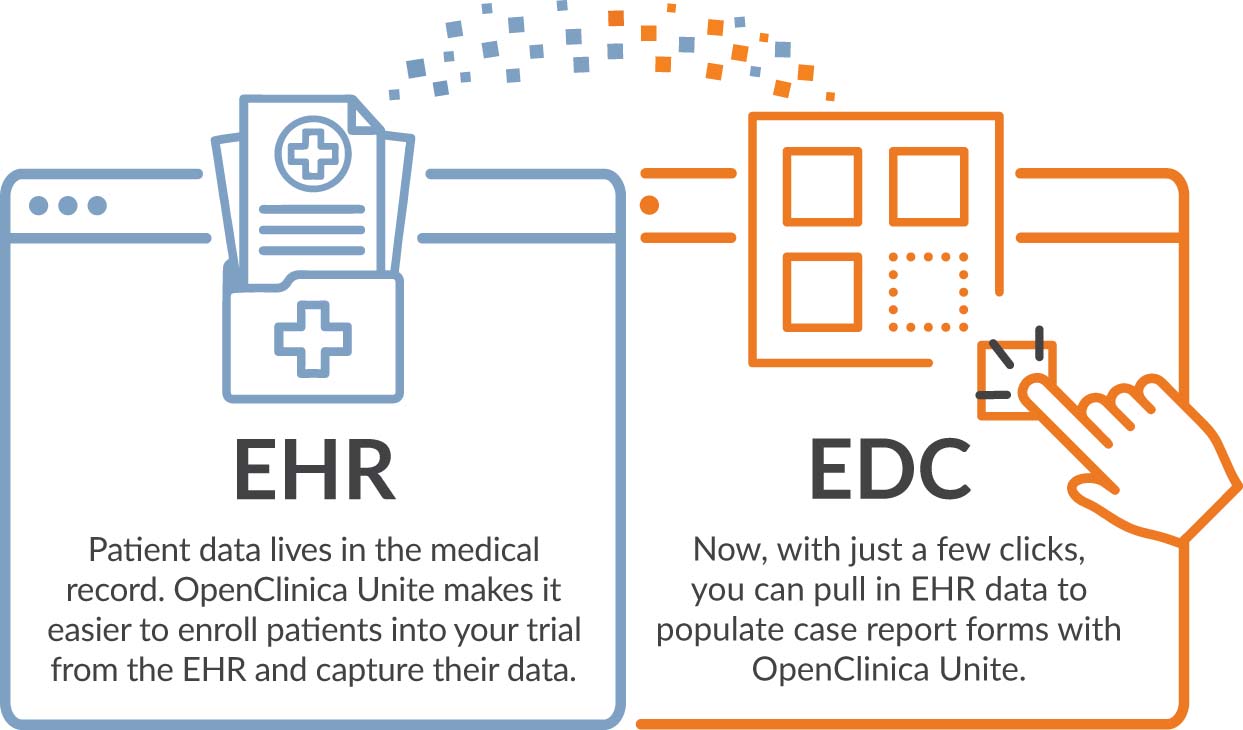
OpenClinica provides a WSDL (Web Service Definition Language) that defines a structured format which allows OpenClinica to accept “messages” from an external system. For example, an EHR system could register subjects for a study in OpenClinica without direct human intervention. At the same time, the EHR could also be programmatically scheduling study events for these subjects. More information about the OpenClinica API can be found on the OpenClinica developer wiki.

An early reference implementation conducted by clinical lab Geneuity used the API to create a web service which inserts data programmatically into OpenClinica CRFs directly from laboratory devices. See the post by Geneuity’s Colton Smith below.

Another major productivity tool in 3.0 is the introduction of a Job Scheduler for automating bulk data import and export.  With this feature users can define a job that will generate an export at a specified time interval.  The Jobs Scheduler can also be configured to regularly scan a specific location for CDISC ODM files and run data imports when a new file is available. This feature can be particularly helpful in automating routing functions, such as the incorporation of lab data into OpenClinica from an external system.  The lab data does need to be in a valid CDISC ODM format (this can be accomplished via another great open source tool called Mirth), but it does save a person from entering data in two applications separately.

At time of this post, OpenClinica 3.0 is currently released as a beta3, but the production ready application is soon to follow. The application is passing through the highly rigorous strictures of our quality system (think Navy Seals training for software) and the output will be fully validated and ready of use in roughly a month. Needless to say, I, and everyone else here at Akaza is very excited to be so close to releasing 3.0. It is already quite clear that this release will have a momentous, positive impact on the community.

Facilitated Data Entry of Lab Results Using OpenClinica’s New Web Services Feature

As mentioned previously, we at Geneuity Clinical Research Services are big fans of OpenClinica and are even more so now with the upcoming release of version 3.0 with its new web services capability.  This article describes how we exploit this new feature to help automate entry of lab results, a particularly important topic given that we do lots of batch testing of specimens and oftentimes test the same specimen for many different analytes.

Prior to 3.0, you had three options when it came to CRF data entry.  The first was to log into OpenClinica’s web interface and manually enter your data.  This was no problem so long as you didn’t have lots and lots of data.  But we did.

Alternatively, you could upload a flat file of your data as long as it was formatted in XML and associated with the appropriate subject id’s and visit descriptions.  Assembling this file wasn’t trivial though and manually looking up each specimen’s subject and event nearly defeated the purpose of the procedure, which was to save time and effort.

Finally, you could do what we did: write custom code to automate the job.  Lab data is amenable to this sort of approach because it is always tagged with something called an accession number that uniquely identifies it.  When designing CRF’s, we always make sure to include a field for the event’s accession number, and when a specimen first arrives through our door the first thing we do is to log into OpenClinica and enter the specimen’s accession number in the appropriate event’s CRF.  Because the number is unique to the study, this entry effectively tags the event and provides a ‘hook’ inside the database so that the event_crf_id of any data item subsequently  annotated with the accession number can be easily looked up using a database query like so: ‘SELECT event_crf_id FROM item_data WHERE value = ‘<accession_number>’.  This, in turn, gives you the requisite information to insert the lab data thusly: ‘INSERT INTO item_data VALUES (‘event_crf_id’, ‘value’ …’ provided you also know the item_id.

To implement this strategy, we wrote custom servlets that operated within the context of our OpenClinica installations.  More recently, we configured MirthConnect channels to do the same.   They worked well and data entry was greatly expedited, but the coding was complex and had to be refactored over and over again for each study and for every CRF change.  While helpful, this strategy wasn’t sustainable in the long run.

Luckily, the latest version of OpenClinica provides a way out.  It incorporates the Spring WS Framework which allows programmers to write something called a ‘web service.’  A web service digests and acts upon XML data sent to it on an on-demand basis over a network.  The source need not be a human being uploading data on a web form, but, more usefully, it can be, say, a clinical testing platform automatically spitting out HL7 messages.  This, of course, is ideal in our case.  So we wrote a web service called ‘EventDataInsert’ that parses XML containing lab data values annotated with accession numbers and item names, looks up the corresponding event_crf_id’s and item_id’s, and inserts the data into item_data accordingly.  The service is generic enough so that it doesn’t have to be refactored for each and every study, but it does make some critical assumptions.  Namely, it assumes that both accession numbers and item names are unique.  So care has to be taken to ensure both these preconditions are met.

The power of EventDataInsert doesn’t just lie in the fact that it handles inserts on an unattended basis, but also in that, like most web services, it requires only simple XML as input.  The latter makes the source of the data irrelevant as long as it can be correctly mapped and transformed into XML.  We often use MirthConnect to do this, using it’s easy-to-use graphical interface to configure channels between incoming raw data and OpenClinica’s web-service interfaces.

The figure below shows a typical deployment of OpenClinica at Geneuity.  MirthConnect is used not only to get data into OpenClinica but also to generate canned PDF reports of the results.  This scenario works for us and gets easier and easier to maintain as OpenClinica evolves new electronic data capture features and makes old ones ever more robust.

Diagram of OpenClinica at Genuity Clinical Research Services

Diagram of OpenClinica at Genuity Clinical Research Services

An Opportunity for Transformational Change in Clinical Trials

Life sciences research is recognized as one of the most technologically advanced, groundbreaking endeavors of modern times. Nevertheless until very recently the preferred technology for executing the most critical, costly stage of the R&D process – clinical trials – has been paper forms. Only in 2008 did adoption of electronic alternatives to paper forms take place in more than half of new trials. This recent uptick in adoption rates is encouraging, but further transformational change in the industry is necessary to fully realize the promise of Electronic Data Capture (EDC) and associated “eClinical” technologies. Two developments that could provide the framework for such change are adoption of open data standards and the use of Open Source Software.

Data standards provide uniform ways to represent information or processes within a specific frame of reference and according to a detailed specification. A standard is “open” when it is not encumbered by patent, cost, or usage restrictions. Open Source Software (OSS) is defined loosely as software that allows programmers to openly read, redistribute, and modify the source code of that software. The combination of OSS and open standards is a proven way to deliver improved flexibility, quality, and efficiency.

A community-driven open source offering that harnesses open standards can produce robust, innovative technology solutions for use in regulated clinical trial environments. Most Open Source Software is built using a collaborative development model. The OSS development and licensing model encourages experimentation, reduces ‘reinvention of the wheel’, and allows otherwise unaffiliated parties to build on the work of others. The result is that OSS can become a key driver of increased IT efficiency and a way to wring out unnecessary costs. In many cases, users can have the best of all worlds: the ability to adopt software rapidly and at low cost, the flexibility to develop and extend their systems as they choose, and the ability to reduce risk by obtaining paid commercial-grade support.

As clinical research struggles to become more automated and efficient, we need to rely on interoperable systems to meet challenges of flexibility, quality, and speed. The OSS development model also naturally leads to the adoption of well-documented, open standards. Because OSS product designers and developers tend to reuse successful components and models where available, OSS technologies are often leading implementers of standards. For example, the National Cancer Institute’s Cancer Bioinformatics Grid (caBIG) initiative is “designed to further medicine’s potential through an open source network” based on open data standards and infrastructure that support sharing of heterogeneous data. This remarkable effort aims to connect large networks of researchers in ways that enables efficient re-use of data, eliminates duplicate systems, and enables new types of translational research.

In industry-sponsored clinical trials, standards such as the CDISC Operational Data Model (ODM), Clinical Data Acquisition Standards Harmonization (CDASH), and Study Data Tabulation Model (SDTM) have gained adoption in both proprietary and OSS software platforms. In some cases, standards are mandated for regulatory submission and reporting (SDTM, clinicaltrials.gov) and obviously must be adopted. Other cases, such as use of ODM, CDASH, and general web standards such as web services and XForms tend to be adopted to the degree they have a compelling business case.

The business case for standards centers on increasing accuracy and repeatability, enabling reuse of data, and enhancing efficiency by use of a common toolset. A well-designed standard does not inhibit flexibility, but presupposes idiosyncrasies and allows extension to support ‘corner cases’. Leading industry voices share compelling arguments how to use standards such as ODM, CDASH, XForms, and Web Services to achieve these goals. Though the details are complicated, the approach offers orchestration of disparate applications and organization of metadata across multiple systems. There is change control support and a single ‘source of truth’ for each data point or study configuration parameter, so when study designs change (as they inevitably do) or a previously committed data point is rolled back, it is automatically shared and manual updates to systems are not necessary. Because the ODM, CDASH, and SDTM are used as a common “language”, the systems know the meaning and structure of data and can process transactions accordingly. Here’s a tangible example:

Lets imagine an IVR system wanted to check with an EDC system if a subject was current in a study (current meaning not dropped out, early terminated or a screen failure).  A Web Service could be offered by the EDC system to respond with a ‘True’ or ‘False’ to a call ‘IS_SUBJECT_CURRENT’ ?  Of course hand-shaking would need to occur before it hand [sic] for security and so on, but following this, the IVR system would simply need to make the call, provide a unique Subject identifier, and the EDC system web service would respond with either ‘True’ or ‘False.  With Web Services, this can potentially occur in less than a second.

Electronic Data Capture – Technology Blog, September 28, 2008

While this integration requirement could be satisfied by development of point-to-point, proprietary interfaces, this approach is brittle, costly, and does not scale well to support a third or fourth-party system participating in the transaction. It is critical that standards be open so that parties can adopt and implement them independently, and later interface their systems together when the business case calls for it. A leading industry blogger makes the case for the openness of standards within the ODM’s ‘Vendor Extension’ architecture: ”The ODM is an open standard, the spec is available for free and anyone can implement it. This encourages innovation and lowers the barriers to entry and therefore costs. Vendor Extensions are not open, the vendor is under no obligation to share them with the market and the effect is that meta-tools and inter-operability are held back.”

Having the software that implements these standards released as open source code only strengthens its benefits. Proprietary software can implement open standards, however given the proprietary vendor’s business interest to lock-in license revenue, might the vendor be tempted into tweaking or ‘extending’ the standard in a way that is encumbered to lock users into their platform? This strategy of “embrace, extend, extinguish” was made famous in the Microsoft anti-trust case of the 1990s, where it came to light that the company attempted to apply these principles to key Internet networking protocols, HTML and web browser standards, and the Java programming language. They hoped to marginalize competing platforms that did not support their “extended” versions of the standards. Thankfully, they had limited success in this effort, and the Internet has flourished into the open, constantly innovating, non-proprietary network that we know today. The eClinical technology field is at a similar crossroads. By embracing open standards, and working concertedly to provide business value in re-usable OSS technology, we can achieve a transformation in the productivity of our clinical technology investments.

OpenClinica 3.0 Features Preview – Part II

Welcome to Part II of the OpenClinica 3.0 features! I previously wrote about three of the main features for 3.0, Source Data Verification, new User Interface for navigation in the system, and a new Home Page for each user.

This post is about three additional features: (i) the new Build Study module, (ii) setting the length and significant digits of items, and (iii) the improved performance of the Subject Matrix.

In 3.0,  all the study build tools will accessed from one main page following a task-based approach. There are five tasks available to the user at the outset. Once the user finishes these first five tasks, two more tasks will become available (see image). This allows the complete study from CRFs to event definitions to sites to assignment of users be done all from a single page. There is also a checklist to let the user easily see how many tasks have been completed so they know how much more configuration is needed before the study is ready to start enrolling subjects.

Build Study Page in OpenClinica

OpenClinica 3.0 also allows the creator of CRFs to set the allowable length of  text fields including the number of decimal places a REAL number should be rounded to. This parameter is set in the OpenClinica CRF Template in a new field called Width_Decimal. The user will specify the width and decimal for a particular field which will force the user to enter the most precise data as possible in a CRF. No longer will the system round to the 4th decimal place at all times and allow up to 255 characters in the field if the CRF creator does not want them to. For example, the creator could specify that a field should have no more than 5 digits total with a maximum of 1 decimal place by entering 5(1) in the Width_Decimal column of the OpenClinica template. If the data entry person tried to enter 3.4444 or 678913 they would told the value is invalid.

By providing this functionality, OpenClinica will help the users get their data into SAS and SPSS more easily.

One of the most important and information-rich pages in OpenClinica is Subject Matrix page, and OpenClinica 3.0 provides significant performance enhancements on this page for studies with large numbers of of subjects.  From the Subject Matrix page users can see a snapshot of where the subjects are in the study, schedule a new event, view a subject record, view a subject event, enter data in a CRF and sign a subject’s record without having to navigate to different pages in this system. A number of users were reporting sluggish performance with the Subject Matrix when they had 5000 or more subjects enrolled in a study.

OpenClinica 3.0 utilizes a new table structure that allows users to load the Subject Matrix containing over 10,000 subjects and 15 event definitions in fewer than 5 seconds (this process could take upwards of a minute in previous releases of OpenClinica).

Please feel free to download the Beta version of OpenClinica 3.0 at http://svn.akazaresearch.com/OpenClinica-3.0-distros/.

OpenClinica 3.0 Features Preview – Part I

We have been working hard on OpenClinica 3.0 for the last 9 months and are getting closer and closer to a production release ready for use in live clinical studies. In the meantime, I wanted to talk about some of the new features over the next few weeks to let folks know what is coming.

OpenClinica 3.0 is sure to bring a lot of excitement to all users of the rapidly growing open source electronic data capture system. A lot of focus in this release has been put on the way trial sponsors use an EDC system and I’d like to point out some of the new features that should enhance their user experiences.

OpenClinica 3.0 will provide a new home page to study-level users providing key information about the progress of a study. These users will be able to see a summary of the subjects enrolled at each site compared to their expected total enrollment as well as the overall subject enrollment for the complete study. Also, these study-level users will be shown a count of the number of study events that are in a particular status. A summary for the number of subject statuses will be displayed so the study-level user can easily see how many subjects are signed, source data verified etc.

OpenClinica 3.0 will provide monitors a workspace to source data verify subjects and their data. The workspace will allow users to source data verify information collected at each visit one-by-one, or verify the information in a bulk process. These two options allow the monitors to perform remote source data verification daily for subjects in the study. Or, if the monitor has to be on site to review and verify information, he/she can go back to their hotel room and check-off verification for many subjects and events at once so they do not have to go one-by-one through every subject and event CRF.

The top-level navigation in OpenClinica 3.0 has been streamlined so site users of the application understand exactly what they have to do after they login. A new home page for investigators and clinical research coordinator users will show the number of queries assigned to them with a link to see every Query assigned them. The home page will show the 5 most recent queries to give the user an idea of what they need to respond to that day.

The new navigation points to the 3 main actions the site users should take. The “Subject Matrix” link will bring them to the new and improved subject matrix in OpenClinica. This matrix will allow users to easily add subjects, schedule events and even enter data from a single, powerful screen. The “Add Subject” link will bring them to a page where they can add a new subject to the study. “Notes & Discrepancies” will bring them to a page where they can see all the queries for their site and allow them to provide a response.

Above is just a small sample of the new features in OpenClinica 3.0. Like I said, I will plan on posting additional features once a week so be sure to check back often. In the meantime, please feel free to download the alpha2 at http://svn.akazaresearch.com/OpenClinica-3.0-distros/.

- Paul Galvin

Follow

Get every new post delivered to your Inbox.

Join 1,590 other followers